
Let’s Be a Little Less Honest

Image result for moron

A few days ago, for some reason or another, my friend and I decided to make a list of negative qualities our future husbands would have to put up with from us. I don’t know whose idea this was. I’m pretty sure it was mine; my friend thinks it was hers, and I’ve decided to let her believe that. Because it was a terrible idea.

I’m a big fan of lists usually. Shopping lists, goal lists, lists of ways to improve my life, lists of my faults, lists of my physical defects—I’ve made them all, usually several times. My favorite is making to-do lists and then accomplishing nothing on them.

But this was different. It lacked the usual joy I find in mutilating my self-esteem. It kept my friend awake at night. The list just grew and grew, starting with very obvious faults I have to things that could be good or bad, depending on your perspective. For example, I’ve been told I don’t care enough about how I look, and yet I know to some people I’m silly and vain and I care too much. So which is it? Let’s put down both!

I’ve been thinking about why this felt so bad, and in the end I’m glad I did it, because it made me realize a few things. First of all, people are not lists—people are not even qualities. Someone kind and nice may be nothing like another kind, nice person. And no one is always nice. A better way of figuring what someone is would be to ask, “When is this person unkind? And why?”

Do you know how complicated people are? I wonder if they can even be reduced to words. The best people cannot, so I wonder why we would strive to be that simplistic, to diminish ourselves. Self-improvement should mean becoming more, not erasing parts of yourself to be more easily described, to be simpler and less messy. My favorite people are the messy ones. How can anyone with depth bond with someone who refuses to ever be complicated? This is what people want. We want to be fascinated by someone, and for that to happen, we have to wonder about them. There has to be something beneath the surface to discover.

The other thing I realized is that you shouldn’t advertise whatever’s wrong with you. Yes, be self-aware, blah blah blah, but that quality is valuable when you need to admit you’re wrong. So tell people if that’s the case. But don’t pass out a list of all the ways you’ve been wrong all your life. Because they will believe you.

Actions only speak louder than words to people who take the time to look at them. Most don’t bother. If you believe you’re hard-working, smart, likable, beautiful, whatever, other people are more likely to believe it too. If you tell them you’re an awkward spaz, you’ll find shortly afterwards they’re teasing you for being an awkward spaz. And somehow that feels way less funny than it did when you were saying it.

Self-deprecating jokes backfire. If you tell people you’re an idiot, you’re going to start convincing them. After all, wouldn’t you know better than anyone else? It also works in reverse. Maybe I take people at face value more than others do, but I have at times been in the presence of women who either believe or desperately need to believe they are wildly attractive and sought after by most men. And they usually are pretty, just not extraordinary. And I leave thinking, if all these people treat you this way, there must be a good reason. Why doesn’t this happen to me? Are you that much better?

People lie, sometimes overtly, sometimes in little ways without even realizing it. They tell you they are who they wish they were, and we listen. Then there are other people, usually more honest people who aren’t so insecure that they can’t admit their flaws, who tell you what they are trying not to be. And then it becomes their epitaph, or at least their punchline.

Me being the moron that I am, I’m probably not going to stop saying negative things about myself. It’s a hard habit to break; there really is something addictive about it. But the next time someone doesn’t take me seriously, I will know that I might be the reason why.



Let’s Be Honest

Image result for honest

In the past few years, I’ve noticed that many people have a problem being honest with themselves. And I understand why that can be hard. The truth isn’t usually nice.

And that’s why you need to be honest with yourself before it’s too late. Otherwise you’ll just have too much baggage to unpack, and very few people are willing to flog themselves over decades of poor judgment or bad behavior. They prefer to take it out on everyone else  (I am one of their personal favorites).

This is not to be confused with being honest about other people. These two types of honesty have very little to do with each other, although they might be inversely related. To paraphrase a line of Agatha Christie’s, people who are brutally honest with others are usually delusional about themselves. They have to be. To criticize others harshly, you have to consider yourself qualified to judge them.

The great (haha) thing about being alone is that it teaches you about yourself. It’s unpleasant, but in the spirit being honest, I will share a few of my findings.

First of all, I need to stop stalking people. They’re beginning to notice.

Not really, that was a joke, but only because I have a few good friends who have forbidden me from my creeper ways. (I have some other good friends who recommend TV shows to me like Crazy Ex-Girlfriend and remark on its resemblance to my life. These friends are what you call enablers.) The problem is less that stalking creeps people out, but that it doesn’t creep some people out, and you should avoid these people. Which is really the opposite of stalking them.

Stalking has never gotten me anywhere worth going, especially when it comes to people my own age. When I was younger and I stalked people inappropriately older, it was a fun diversion that never lead to anything but moping over unrequited feelings. Alas, none of my teachers ever loved me back. They did, however, stop answering my emails. Even the college professor I once tried to woo, who was single and only a measly 8 years older than me, purposely did not say hello to me outside of class. I gave a long presentation in class to impress him, around twice the length it was supposed to be, and as a result he made signs saying “Five minutes left” and “Stop” that he used in subsequent lessons. As you may have surmised, we are not currently married.

If you stalk, pursue, chase or whatever someone and you get them, you’re always going to be in the position you started out in. And it’s not nice to continually reach for someone. It doesn’t pay off, and it should never be necessary in the first place. There are people in the world who will like you even if you don’t memorize their schedule and write it down in code on your binder. And you don’t want the sort of person who finds that kind of thing endearing anyway (although in my experience, no one does).

So I’m giving it up. No more stalking. At least not very much. It’s a little hard to stop completely when you have a related character flaw: joy in obsession. I like to obsess about people. I like to daydream about them, then listen to sad music and weep into a tissue. On a productive day, I may even write a poem. I used to think it meant something. This was my second epiphany: we (if you’re like me) look for people to play out the fantasies in our head with. The person is less important than the fantasy. Which is fine as long as you know it doesn’t mean anything. 

It’s very easy to forget that, and when I inevitably do, I will remind myself of the product of this soul-searching: not to act on anything I think or feel. I don’t think this is going to go well. If you’re here because I accidentally liked one of your photos from 5 years ago, I’m sorry.

I Finally Attend Kindergarten

Image result for kindergarten

I never went to kindergarten as a child. My mother believed that was just too young an age for me to be without her, so she homeschooled me instead and sent me off into the world when I was six. So logically, I quit my high-paying, perfectly acceptable job teaching high school for one in an educational setting I have zero experience in for a much lower salary. Did I mention that I’ve been scared of children ever since my cousin used to hit me as a toddler?

So far it’s actually been a great choice—children seem to like me, I’m no longer wistfully contemplating suicide, and it’s much more rewarding overall. There’s nothing like getting a hug from a four-year-old.

Or being punched in the stomach by one. One child I’ve had the privilege of dealing with announced on our first day together that he does not like teachers. He only likes mommy. The next day he decided he liked me and wanted to go home with me, only to dislike me again a little while later. It was weirdly reminiscent of my interactions with adult men.

Since then, he has alternately loved me and hated me depending on my willingness to let him do whatever he wants. I refused him a certain box of toys once, and as a result he kicked me, hit me, tried to bite me, threw something at my head, and chased me with a pair of scissors while saying, “I CUT YOU!”…Twice.

But for some reason I forget all of that when he runs up to me in the hall, says, “I like you,” and wraps his arms around my leg.

One thing I won’t forget, however, is the five-year-old who identified a picture of a dog as “a bitch”. I don’t know who taught him that and I don’t want to know, but nothing I ever heard in high school left me that speechless.

I hope this is one job I can stand without losing my sanity, which is worth the thinly veiled disappointment of my relatives. And somehow I think it might be, because there’s something really nice about hearing kids tell you that their mother is very fat and the teacher uses her phone when you aren’t in the room. It might even be worth getting sneezed on, drooled on, and physically assaulted. As long as no one pees on me, because that I am not okay with.

Sensitivity is Not Weakness

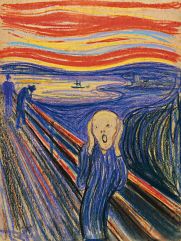
scream

“Keep a stiff upper lip,” people like to say, or, “Make them wonder how you’re still smiling.”  No matter what life does to you, you should get back up on your feet and face it all. Don’t you know that if you react properly under intense pressure, you might just turn into a diamond?

On one hand we are told that life is short and we should not spend it being miserable, that anyone or anything that makes us unhappy should be cut out of our lives. On the other, we hear about how our greatest strength is enduring hardship.

I don’t buy into this idea that putting up with stress and tragedy, letting it affect you as little as possible, is somehow superior. Some people do praise the courage that is required for vulnerability, and others say that “only the gentle are ever truly strong,” but none of these express the real value of sensitivity.

I used to think I was not a sensitive person, which was odd considering the emo journals I have from this time period (and all of my life), but the day a ouija board made me cry was the day I gave up that delusion.

I’ve wondered many times how other people manage what would be unbearable for me, but I also wonder if they have given up on happiness. The greatest advantage to sensitivity, I have found, is that it drives you to improve your life. I can’t handle what many people accept, and the result is that I’m forced to stand up for myself even though I naturally hate to.

When you feel deeply, you reach the limit of emotional pain that you can put up with sooner than others, and so you react sooner. When you experience your feelings viscerally, you can’t ignore them. When you can’t function until you’ve worked through your emotions—you work through them. It’s impossible for a highly sensitive person to accept a lifetime of stress and unhappiness, because these feelings will always be at the forefront of their consciousness. And this is why sensitivity is a strength: it is the force that propels you to improve your life when many people would simply stand still.

You may suffer more, but you will also be more responsive to joy. If a part of your body loses the ability to feel it will not be considered stronger than your other limbs but much weaker. After all, your body should know when to move away from a source of pain. And this is what sensitivity is. It protects us by pushing us away from what hurts us because it is harder to stay than to leave. The downside to this is that sometimes, if you’re like me, you may end up hiding in the bathroom when you’re uncomfortable (or under a desk), but that’s only temporary until you create a place for yourself that you don’t need to run away from.

What is sensitivity, really, except the expectation that we should be treated well? Hurtful actions are only those we do not accept as normal. And the belief that we deserve a good life, with people who love us well, is not a shortcoming. It is the very least we need to pursue our dreams, and we should not be apologizing for it.

The Expat’s Guide to Kuwait

Kuwait

Welcome to Kuwait. Great choice! I, personally, have been trying to get out for the past 15 years, but to each their own. Here is my guide to this fair nation:

Clothing and Conduct

The first thing many Westerners learn about Kuwait is that there is no alcohol and that they have to cover up. The conservatism might be scary, but what you may not realize is that Kuwaitis don’t expect foreigners to fit in. Kuwait is not a melting pot despite the many nationalities because very little is melting. Each group of expats forms their own subculture, where they do many of the same things considered acceptable in their homeland.

So, Kuwaitis don’t expect you to cover up like them but just to look like you’re trying. Arab women are experts at wearing layers of clothing to hide everything they want to and you probably can’t compete with this sort of lifelong training. What you think of is modest is probably considered immodest here anyway.

When I was in middle school, a Canadian friend of mine told me her mother bought her a one piece bathing suit when they moved to Kuwait because, “No bikinis in Kuwait.” Looking back, this is funny to me. Anywhere you can wear a one-piece in Kuwait, you can probably wear a bikini. The general public disapproves of both.

But, you may say, plenty of Arab women wear provocative clothing. Yes, but if you do it it’s perceived as disrespectful. When Arabs do it it’s just because they’re slutty and raised badly. Many Kuwaitis assume your entire continent was raised badly so your job is merely to hide it.

It is ironic that a country so hot should require so much clothing. The climate suggests Kuwait could be the world’s largest beach party. But no. My personal theory is that the people are so religious because they live in a constant reminder of hell.

The Kuwaitis You Will Meet

Kuwaitis are not a homogenous group, despite the considerable external pressure we face to become one. Your impression of us could vary greatly depending on who you interact with. These are the groups I have identified:

The very conservative and not very educated group: This group probably disapproves of you the most, but you will also have the least interaction with them if you work in the places that typically employ Western expats. Most of their opinions of Americans are based on what they see on T.V. Someone from this group once asked my sister if she had met Paris Hilton when she was studying in the U.S. In general, they’ll be fine with you as long as you don’t try to marry their children.

The conservative and educated group: For the most part, this group will treat you respectfully. Many Kuwaitis study abroad and have a decent understanding of Western culture. You will even meet some very religious people who approach their beliefs in an enlightened and well thought out way. Plenty define themselves as moderate but still seem pretty conservative compared to the rest of the world.

The liberals: This group is very hit or miss. I am in this group. (I am clearly a hit.)  Some members are truly open-minded and Westernized while others think Americans snort cocaine in their bathrooms. No, they aren’t judging you for it, they think it’s normal and expect you to give them your drugs. Some people just pretend to be “open-minded” as an excuse to do whatever they want. Then they have a traditional marriage to their cousin. Approach with caution.

Dating the Locals

If you’re an expat dating an Arab man, you may find people jump to some unflattering conclusions. Your friends may warn you about Kuwaiti guys. Kuwaitis may warn you about Kuwaiti guys. The interesting thing, though, is that these stereotypes don’t seem to exist about dating Arab women, but I know plenty of Westerners married to Arab men and far fewer Westerners married to Arab women. So, by all means be cautious, but I think some of the judgment here is unfounded.

The Racial Hierarchy

My purpose here is not to offend anyone but just to be honest. So I hope we can admit that like most if not all countries in the world, Kuwait is racist. And there is a bizarrely distinct sort of pecking order.

Kuwaitis are on the top in terms of power and influence, but white expats hover nearby. They are frequently preferred for employment and housing over Kuwaitis. Schools want foreigners. Landlords think Kuwaitis are bad tenants. They will discriminate, and they will say to you directly that this building is only for foreigners. The interesting thing is that I don’t think Kuwaitis particularly like Americans or vice versa. They don’t approve of how “loose” the culture is or many of the government’s political/military moves. But they’d still rather hire an American teacher than an Egyptian one. On the other hand, many Americans adopt a sort of white supremacist attitude towards Kuwaitis. But they stay. In fact, the less they like brown people, the more likely they seem to come here in the first place. I don’t know why.

The next tier is the non-Gulf Arabs. For some reason everyone seems to dislike Egyptians. Kuwaitis dislike Palestinians because they sided with Saddam Hussain during the Gulf War. Lebanese people are considered hot but too “free.” Lebanon is kind of like the Paris of the Middle East. My uncle once said to a friend of his, “Look at how ugly you are and your mother is Lebanese. Imagine how ugly you would be if your mother was Kuwaiti.” I guess that sums it up.

The lowest group is the South Asian expats. They are treated badly by almost every other group, but sometimes more so by the people who are constantly pushed around by Kuwaitis. They’re the ones everyone seems to kick around to feel better about themselves. It makes me sad.

In Conclusion

I don’t mean to suggest Kuwait is a bad place. It has its good points. It’s comfortable. I almost never have to leave the house to get groceries. The people are usually friendly and they expect to meet many foreigners. I’ve spent most of my life here while barely speaking any Arabic. I don’t think I could get through the day in the U.S. without speaking English. One other advantage is that I find it to be less fattening than other countries because you can’t really walk down a city street and look at all the bakeries. And the grocery stores have far fewer pies, although on some days I consider this a major disadvantage.

In some ways it’s a great place to live, but it can still be a big adjustment. This is my honest take on the stuff most other guides leave out. Feel free to ask questions!


Reflections on My First Two Years as a Teacher, Part 3

notebookopen

Here it is: the third and final installment in this series. I would write more but I’ve started my third year of teaching, and if I blog about my students and employers while I work there, I may get fired.Which I don’t want, since everything is going great. Except for the day when I got confused about when school started and showed up almost an hour late, which wasn’t my fault, although for some reason it didn’t happen to anyone else in the entire school. Not even the person I told to come at wrong time. There have been days in the past two years when I have felt unemployable, and that was one of them.

My new school is a big change, primarily because it does not measure success in staff and student tears. So far no one wants me to suffer, and no one wants me to quit. It makes me uncomfortable. I feel like they don’t know what I’m like yet, and when they figure it out, they too will seek to squash me like a bug.

But I’m trying not to let that happen. For example, apparently they can’t stand it when teachers come late. Late is my middle name. “Issues with time” is one of the top three personality traits that make me who I am. But I haven’t come late once in the past two weeks, except for the day I got confused, and while that doesn’t sound like an accomplishment, it is for me (yes, I am that bad).

Something I’m happy about, though, is the lack of discipline problems I’ll have to deal with. I told another teacher about Fire Boy from my last school, and she was horrified. “The biggest issue I’ve had to deal with was a couple years ago when a student spilled mouthwash in class,” she said.

Excuse me? I didn’t show how confused I was because I didn’t want to seem like the unqualified teacher who doesn’t get what’s wrong with mouthwash, but I did not see the problem. Was she throwing the mouthwash at someone? Was she drinking it for the alcohol content? If clumsiness is a discipline issue, I’ll end up sending myself to the principal. Also, I don’t think that teacher appreciates how lucky she is to have students hygienic enough to carry mouthwash with them to school. Fire Boy probably would have found a way to turn it into an explosive.

I truly don’t have much else to say on this topic right now, almost as if I have come to peace with the last two years. That can’t be entirely true because I recently dreamed I took my boy’s class to a hospital and they trampled a disabled child, but I think I’m getting there. I feel like I’m already a better teacher than I was two weeks ago, and it makes me sad that I couldn’t be as good with my last students. I’m also sad because I miss them. You spend a year trying to get through to a group of people, and if you put your heart into your work, the sense of loss is inevitable. The teacher’s curse is caring about their students even when the students do not care about them.

On a lighter note, we had a professional development lecturer come and, since he was a math teacher, he used math problems in his examples. I left feeling great about myself since I know that 16 X 5 is not 400. I used to think this was a joke:

Image result for i don't know basic math meme

It’s not. It’s definitely not. That’s all I’m going to say.

Reflections on My First 2 Years as a Teacher

One of the first things that surprised me when I began teaching was how absolutely exhausting it was. I’d never experienced such exhaustion in my life. Other teachers told me I would adapt, which I did, and to improve my diet, which I didn’t.

Then, my tiredness was replaced by difficulty sleeping due to anxiety and nightmares about my colleagues. Now I no longer worry about teaching depleting my energy since I discovered I never had any in the first place. I’m on summer vacation and I’m still tired, and believe me, I’m not doing anything. Since I have a new job coming up and I am hoping it will be much better than the last one, I should probably get myself checked for the anemia people keep telling me I must have.

My last job. Where do I begin? It was my first job and my introduction to teaching. It also destroyed my self-esteem. But I learned a lot from it.

On a positive note, I learned that teachers really love their students. I never knew I would care about my students the way that I do. I certainly never cared that much about any of my teachers when I was in school. I can’t say I’m not flooded with joy because I never have to deal with a certain difficult class of mine again, but I have a soft spot even for some of my most irritating students. I cherish memories I have with all my classes, even if I don’t want to/probably couldn’t live through them again (but that is a post for another day). Students are truly the best part of teaching. I wonder if they know how much even the smallest nice thing they say or do means to me.

The worst part of teaching—and this was a surprise to me—is other teachers. Is there something about the profession that attracts the mentally unwell? Are many teachers not actually caring adults but individuals so insecure they get satisfaction from having power over children? I’ve met many great teachers, teachers that are organized, professional, disciplined, and respected by their students, and I’m in awe of them because I am none of those things. But then there are the others. I have never met a teacher who didn’t think they were great at their job, which is odd, because I certainly didn’t have many good teachers growing up. In fact, I barely remember most of them. They can’t all be good. But they are quick to defend themselves against any criticism and even quicker to give it out. Is the subject matter we teach our students really more important than teaching them to be kind, humble, and above all, self-aware? We are supposed to be an example, but some teachers are worse bullies and gossips than most of the students. It’s very sad. I don’t think many students know just how messed up things are behind the scenes. But it shows in the end, because a school can’t really be any better than its teachers.

I guess this kind of behavior comes from insecurity, which puzzles me a bit. Where are the teachers who manifest their insecurity like I do, in a raging case of imposter syndrome and by hiding from people who scare them in empty classrooms and under desks? Maybe arrogance is a better coping mechanism for low self esteem when you have to tell teenagers what to do for a living. It’s exhausting to be unsure of yourself/convinced you don’t know what you’re doing and be hoping your students don’t notice. Especially because they do notice. However much they can seem like blockheads, they are good at reading their teachers (if not much else). This became very clear to me once when a student asked me if I was an adult. Much like wild animals, students can smell fear.

Ironically, when I was a teenager and participating in school activities like bake sales, the children thought I was a teacher and said they were scared of me. Now I actually am a teacher, and no one is scared of me.

I am proud, however, that I have gone two years without crying in class, thereby proving my brother’s predictions wrong. I have almost cried in class multiple times, and cried in front of other teachers and school administrators, but not in front of students. This is partly due to not having lost all of my pride and self-respect (yet), and partly due to not wanting them to laugh at me. But whatever, I still haven’t done it.

Part two of my reflections on my first two years of teaching will be coming soon because I still have a lot more to say about it, and writing about it is cheaper than the therapy I desperately need.